


The awards support creative, innovative research with a broad impact.
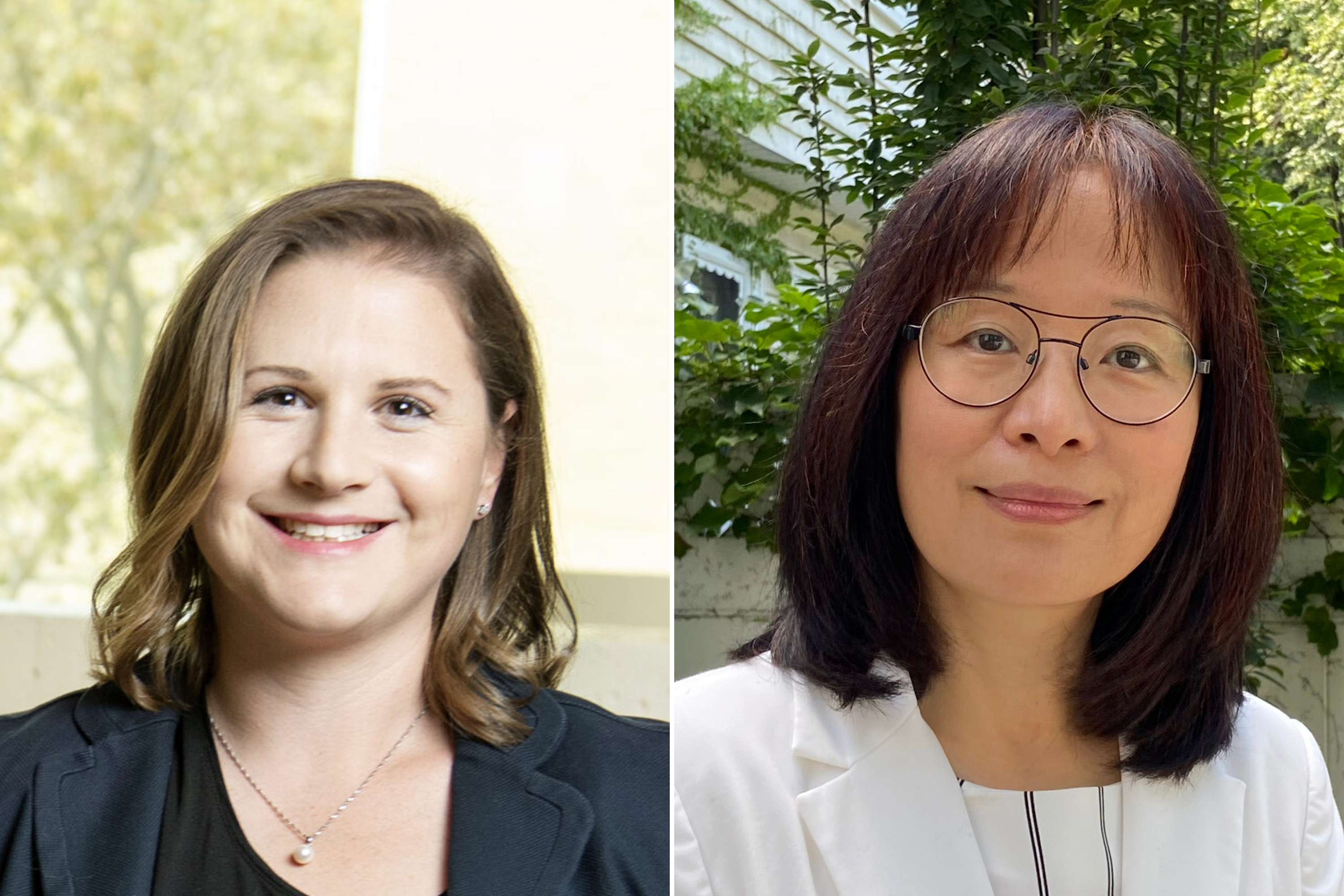
The National Institutes of Health (NIH) has awarded grants to MIT’s Ariel Furst and Fan Wang, through its High-Risk, High-Reward Research program. The NIH High-Risk, High-Reward Research program awarded 85 new research grants to support exceptionally creative scientists pursuing highly innovative behavioral and biomedical research projects.
Ariel Furst was selected as the recipient of the NIH Director’s New Innovator Award, which has supported unusually innovative research since 2007. Recipients are early-career investigators who are within 10 years of their final degree or clinical residency and have not yet received a research project grant or equivalent NIH grant.
Furst, the Paul M. Cook Career Development Assistant Professor of Chemical Engineering at MIT, invents technologies to improve human and environmental health by increasing equitable access to resources. Her lab develops transformative technologies to solve problems related to health care and sustainability by harnessing the inherent capabilities of biological molecules and cells. She is passionate about STEM outreach and increasing the participation of underrepresented groups in engineering.
After completing her PhD at Caltech, where she developed noninvasive diagnostics for colorectal cancer, Furst became an A. O. Beckman Postdoctoral Fellow at the University of California at Berkeley. There she developed sensors to monitor environmental pollutants. In 2022, Furst was awarded the MIT UROP Outstanding Faculty Mentor Award for her work with undergraduate researchers. She is a now a 2023 Marion Milligan Mason Awardee, a CIFAR Azrieli Global Scholar for Bio-Inspired Solar Energy, and an ARO Early Career Grantee. She is also a co-founder of the regenerative agriculture company, Seia Bio.
Fan Wang received the Pioneer Award, which has been challenging researchers at all career levels to pursue new directions and develop groundbreaking, high impact approaches to a broad area of biomedical and behavioral sciences since 2004.
Wang, a professor in the Department of Brain and Cognitive Sciences and an investigator in the McGovern Institute for Brain Research, is uncovering the neural circuit mechanisms that govern bodily sensations, like touch, pain, and posture, as well as the mechanisms that control sensorimotor behaviors. Researchers in the Wang lab aim to generate an integrated understanding of the sensation-perception-action process, hoping to find better treatments for diseases like chronic pain, addiction, and movement disorders. Wang’s lab uses genetic, viral, in vivo large-scale electrophysiology and imaging techniques to gain traction in these pursuits.
Wang obtained her PhD at Columbia University, working with Professor Richard Axel. She conducted her postdoctoral work at Stanford University with Mark Tessier-Lavigne, and then subsequently joined Duke University as faculty in 2003. Wang was later appointed as the Morris N. Broad Distinguished Professor of Neurobiology at the Duke University School of Medicine. In January 2023, she joined the faculty of the MIT School of Science and the McGovern Institute.
The High-Risk, High-Reward Research program is funded through the NIH Common Fund, which supports a series of exceptionally high-impact programs that cross NIH Institutes and Centers.
“The HRHR program is a pillar for innovation here at NIH, providing support to transformational research, with advances in biomedical and behavioral science,” says Robert W. Eisinger, acting director of the Division of Program Coordination, Planning, and Strategic Initiatives, which oversees the NIH Common Fund. “These awards align with the Common Fund’s mandate to support science expected to have exceptionally high and broadly applicable impact.”
NIH issued eight Pioneer Awards, 58 New Innovator Awards, six Transformative Research Awards, and 13 Early Independence Awards in 2023. Funding for the awards comes from the NIH Common Fund; the National Institute of General Medical Sciences; the National Institute of Mental Health; the National Library of Medicine; the National Institute on Aging; the National Heart, Lung, and Blood Institute; and the Office of Dietary Supplements.



Discussion about this post