


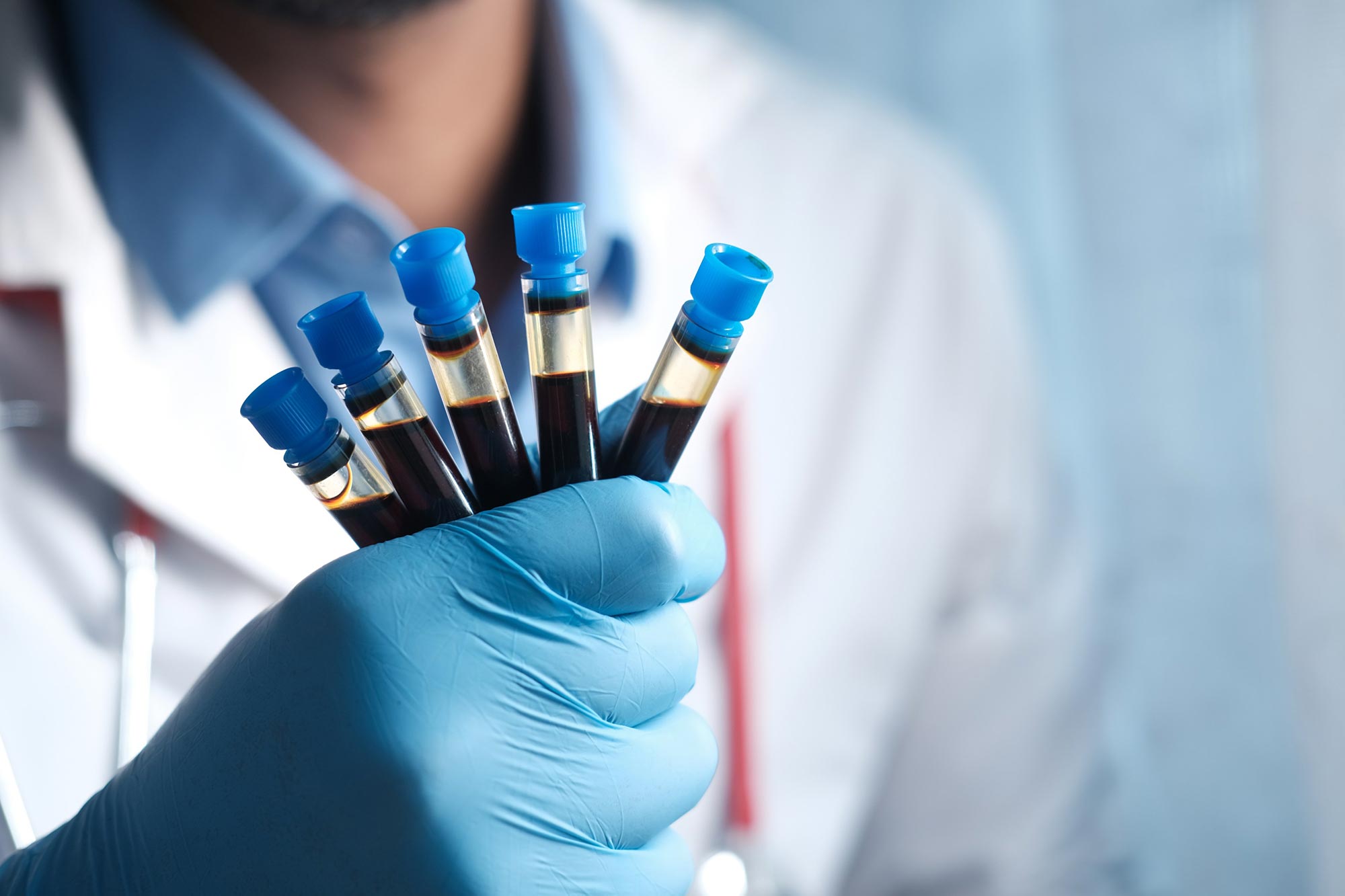

New research warns that blood tests for Alzheimer’s disease may be unreliable, particularly for Black patients.
A recent study conducted by Rutgers Health indicates that blood tests for Alzheimer’s disease need to be interpreted with caution – particularly for Black patients.
“These tests are currently geared towards primary care physicians and directly to older adults concerned about cognitive performance,” said William Hu, senior author of the paper in Alzheimer’s and Dementia, director of the Rutgers Center for Healthy Aging Research, and Chief of Cognitive Neurology & Alzheimer’s Disease Clinic. “They may provide some value to primary care doctors who understand their limitations, but there is no reason for patients who have concerns about their memory to buy these tests, which cost $1,200 to $2,000 and are almost never covered by insurance.”
Levels of an Alzheimer’s biomarker are much lower in the blood than in the spinal fluid, where it has been validated as a diagnostic tool for white patients. This discrepancy is even greater for Black patients, who naturally have lower biomarker levels in their spinal fluid. Additionally, impaired memory function can further elevate biomarker levels in the blood.
Challenges of Blood-Based Testing
“The blood tests have many caveats,” Hu said. “Poor transfer of these proteins from spinal fluid to blood means many patients will go undiagnosed, especially if their disease is mild, while the ability of other ailments to increase these proteins in the blood mean tests produce false positives.”
The researchers examined test results from patients at Rutgers and Emory University. Both cohorts included Black and non-Hispanic white participants. The Rutgers cohort also included ethnic Chinese participants.
“For Black patients, it’s a double whammy,” Hu said. “Not only will you have a harder time using these proteins in the spinal fluid to diagnose Alzheimer’s disease in Black patients, you will further reduce the detection rate by relying on the blood tests.”
Significant Racial Disparities in Test Performance
All 221 participants underwent detailed clinical evaluations and brain imaging. Most had both blood and spinal fluid samples collected on the same day. The research team used automated testing systems to measure levels of specific proteins – particularly p-Tau217 – in both blood and spinal fluid samples.
The researchers found a 70% correlation between protein levels in spinal fluid and blood. The racial disparities, moreover, were significant. When using a blood p-Tau217 threshold optimized for detecting Alzheimer’s, the test showed 90.3% sensitivity (chance of diagnosing patients with disease) and 81.1% specificity (chance of correctly identifying someone as not having the disease) in white participants but 73.7% sensitivity and 72.5% specificity in Black participants.
The positive predictive value – the chance of actually having the disease when the test is positive – was much higher in white participants (87%) than Black participants (58%). These differences persisted even after accounting for known racial differences in spinal fluid protein levels, suggesting the blood test introduced additional disparities beyond what was already known.
Among patients of Chinese ancestry, test performance roughly matched its performance in white patients.
Hu added the tests may eventually prove useful but need significant refinement.
“In another five to 10 years, these tests may get to the point where we can reliably use them, but right now, they are similar to some of the home COVID tests that had accuracy issues,” he said.
The researchers emphasized that anyone with memory concerns should see a neurologist for a comprehensive evaluation rather than relying on blood test results alone. They said roughly half of all Americans with Alzheimer’s are thought to be undiagnosed, particularly those with early-stage cases that can benefit most from treatment.
Reference: “Influence of cognitive impairment and race on plasma p-Tau217 in two diverse cohorts” by Ashima Nayyar, Mei-ling Li, Victor Sotelo, Guibin Su, Isabelle Hwang, Milota Kaluzova, Mini Jomartin, Michelle Migut, Hilary Grosso Jasutkar, Karlyndsay Sitterley, Karthik J. Kota and William T. Hu, 23 February 2025, Alzheimer’s & Dementia.
DOI: 10.1002/alz.14585
W.T.H. has received research support from NIH, Robert Wood Johnson Foundation, Fujirebio Diagnostics Inc, Atlanta Family Foundation, and TMCity Foundation; has consulted for Apellis Pharmaceuticals, Beckman Coulter Diagnostics, Biogen, Fujirebio Diagnostics Inc; has patents on CSF-based diagnosis of FTLD-TDP, prognosis of MCI due to AD, and prognosis of spinal muscular atrophy on gene therapy; and has copyright on Mandarin-based cognitive assessments (licensed to Linus Health). H.G.J. has received research support from Glenn Foundation for Medical Research and American Federation for Aging Research. A.N. has nothing to disclose. M.L. has nothing to disclose. V.S. has nothing to disclose. I.H. has nothing to disclose. M.K. has nothing to disclose. M.J.M. has nothing to disclose. M.M. has nothing to disclose. K.S. has nothing to disclose. K.J.K. has nothing to disclose.



Discussion about this post